
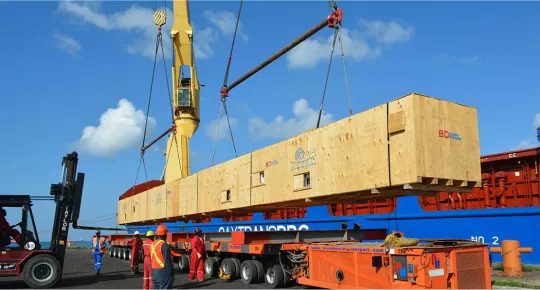
What is project cargo?
Project cargo is the specialist logistics discipline covering the planning, transport, and delivery of oversized, overweight, or structurally complex loads that cannot move as standard containerised freight. The category includes industrial machinery, power-generation equipment, petrochemical plant sections, construction cranes, bridge elements, wind and solar farm components, and any other cargo that is out-of-gauge (OOG), meaning it exceeds standard container dimensions, or that requires engineered lifting and rigging rather than normal handling.
GHO Express has managed project cargo and heavy-lift campaigns from Lebanon since 1971, building the expertise, carrier relationships, and permit-handling capability that these shipments demand. Our team has coordinated moves for energy, construction, and industrial clients across the Middle East, treating every project as a standalone logistics engineering exercise.
Project cargo services we provide
- Route surveys and feasibility studies, on-the-ground assessment of road paths, bridges, underpasses, and port gates to confirm the move is safe and legal before anything moves.
- Lifting and rigging coordination, selection of the right cranes, SPMTs (self-propelled modular transporters), and rigging hardware, with lifting plans reviewed by qualified engineers.
- Out-of-gauge (OOG) breakbulk shipping, booking and stowage on multipurpose or heavy-lift vessels, including sea-fastening plans.
- Abnormal-load road transport, specialist heavy-haul trucks and trailers with police escort where required.
- Air charter for urgent oversized cargo, when timelines are critical, we arrange cargo aircraft or part-charters through our all-mode charters capability.
- Customs clearance for project equipment, handling temporary admission, ATA carnet, and permanent import formalities. See customs clearance.
- Port and airport supervision, on-site representation at Beirut Port, Tripoli Port, and Rafic Hariri International Airport’s Cargo Village.
- Multi-modal sequencing, combining sea, road, and sometimes air for multi-leg project campaigns.
How a project cargo move works, step by step
- Scope and feasibility. You provide item dimensions, weight (gross and centre-of-gravity), origin, destination, and delivery deadline. We review the data and flag any transport constraints.
- Route survey. Our team physically surveys (or commissions a survey of) every road section between origin and port/airport, producing a written report with photos and clearance data.
- Engineering the plan. We prepare a lifting and rigging study, a stowage and sea-fastening plan (for sea moves), and an abnormal-load permit application for Lebanese authorities.
- Carrier and equipment booking. We select and book the most appropriate vessel class (heavy-lift, multipurpose, or RoRo), heavy-transport trucks, and cranes. For air moves, we coordinate with charter operators.
- Export customs and permits. Our brokers handle Lebanese export formalities and abnormal-load road permits, coordinating with port or airport authorities for berth and gate approvals.
- Load-out and sea/air fastening. We supervise the physical load-out, rigging, and fastening to ensure cargo is secured to the applicable marine or aviation standard.
- Transit monitoring. Our team tracks the shipment through every transit point and coordinates with our global agents at the destination country.
- Import clearance and final delivery. At destination, our partner network manages import duties, local permits, and the last-mile delivery to your site.
Out-of-gauge vs. breakbulk, understanding the terms
The terms overlap but are not identical. Out-of-gauge (OOG) means the cargo exceeds the external dimensions of a standard 20ft or 40ft ISO container in at least one direction. OOG cargo may still travel in a flat-rack or open-top container if only slightly over-dimension. Breakbulk means the cargo is shipped as loose pieces on deck or in the vessel’s hold, without any container at all. Very large or very heavy items, turbine nacelles, pressure vessels, offshore modules, typically move as breakbulk on dedicated heavy-lift vessels.
GHO Express handles both categories, and we advise which mode is most cost-effective and practical for your specific dimensions and weight.
Documentation checklist for project cargo
Prepare the following before shipment:
- Commercial invoice and packing list
- Detailed weight and centre-of-gravity certificate (factory-issued)
- Engineering lifting plan / rigging study
- Stowage and sea-fastening plan (for sea freight)
- Abnormal-load road-transport permit (Lebanese authorities)
- Certificate of origin
- Cargo insurance policy (replacement value, all-risk, institute cargo clauses)
- Temporary admission or permanent import documents (destination country)
- Export-control compliance statement (for controlled equipment)
We build the document checklist at the start of every project so nothing is missing when the cargo arrives at port or airport.
Energy and construction projects, our core sectors
Project cargo is most common in energy and construction. In Lebanon and across the region, the types of equipment we regularly handle include:
- Power generation, diesel generator sets, gas turbines, transformers, switchgear modules.
- Oil and gas, pressure vessels, heat exchangers, compressor trains, drilling-rig sections.
- Renewable energy, solar tracker systems, wind-turbine components (towers, nacelles, blades).
- Construction, tower cranes, prefabricated steel structures, bridge girders, piling rigs.
- Industrial plant, complete production lines, chemical reactors, kiln sections.
For each sector, weight, fragility, and sensitivity to vibration or tilt vary significantly. We tailor the handling and transport method accordingly.
Coverage
Our physical operations are based in Lebanon, Beirut HQ at St. Charles City Center (Mina El Hosn) and our airport cargo office at Rafic Hariri International Airport (LAT Building, Cargo Village). From these two bases we plan and execute project cargo moves out of and into Lebanon, then hand off to our trusted global partner and agent network for the international legs, including port-to-site delivery at the destination. We do not claim offices or branches outside Lebanon, but our network covers the key energy and construction markets in the Gulf, Africa, Europe, and beyond.
Why GHO Express for project cargo
- Since 1971, over fifty years of managing complex, high-value cargo through Lebanese ports and airports.
- FIDI member, international quality and compliance standards across our operations.
- On-site airport and port presence, hands-on supervision where it matters most.
- Genuine multi-modal capability, sea breakbulk, air charter, heavy-haul road, and combined logistics under one management team.
- Honest scope, we tell you early if a move has constraints, not after the truck is at the gate.
Planning a project shipment? Request a project cargo consultation with your item’s dimensions, weight, origin, and delivery window. Our team will respond with a preliminary feasibility assessment and a route recommendation.
Related services
Frequently asked questions
What is project cargo and how is it different from standard freight?
Project cargo refers to single shipments or coordinated multi-leg campaigns involving oversized, overweight, indivisible, or high-value industrial loads, such as turbines, generators, drilling rigs, transformers, modular plant sections, and prefabricated structures. Unlike standard freight, each project cargo move requires a bespoke transport plan: route surveys, structural engineering sign-offs, specialist lifting equipment, and close coordination with port authorities, road agencies, and sometimes civil works teams. GHO Express has managed project cargo of this type since 1971.
What routes and destinations can GHO Express handle for project cargo?
We plan and execute project cargo out of Lebanon's ports (Beirut Port and Tripoli Port) and Rafic Hariri International Airport for out-of-gauge breakbulk or air-charter moves. Through our global partner and agent network we handle the Lebanon leg and coordinate the full transit to destinations in the Gulf, Europe, Africa, and beyond. We do not have physical offices outside Lebanon, but our network ensures professional handling at every point of the cargo's journey.
What does a route survey for heavy-lift cargo involve?
A route survey examines every kilometre of the planned road path to verify that bridges, underpasses, utility cables, turning radii, and road surfaces can safely accommodate the load and the heavy-transport vehicle. The survey produces a detailed report identifying obstacles, required road-widening, temporary cable lifts, and any works needed before the move. For port-to-site or airport-to-site hauls in Lebanon, our team coordinates with Lebanese road authorities and, where necessary, police escort arrangements.
What is breakbulk and when does cargo ship as breakbulk instead of in a container?
Breakbulk cargo is shipped as individual pieces, without being loaded into a standard intermodal container, because the item is too long, too wide, too tall, or too heavy to fit. Common examples include steel fabrications, large pipes, industrial boilers, wind-turbine blades, and construction cranes. Breakbulk usually moves on multipurpose or heavy-lift vessels with on-board cranes, and the booking, stowage, and sea-fastening plan require specialist expertise that GHO Express has provided for over fifty years.
What documents are typically required for out-of-gauge and heavy-lift shipments?
In addition to the standard commercial invoice and packing list, project cargo commonly requires: a detailed weight and dimension certificate, a lifting plan or rigging study signed by a structural engineer, a stowage and sea-fastening plan, special permits from Lebanese road and port authorities for abnormal-load transport, a certificate of origin, and cargo insurance covering the full replacement value. For energy-sector equipment, export-control compliance documents may also apply. We compile the full checklist at the quoting stage so there are no surprises.
How early should I involve GHO Express in a project cargo move?
The earlier the better, ideally at the engineering or procurement stage, before dimensions and weights are finalised. Early involvement lets us flag any transport constraints that could influence the design (for example, maximum beam width for Lebanese port access), identify long lead-time permits, and plan the most cost-efficient routing. For complex campaigns involving multiple lifts or sequential deliveries to a construction site, we build a master transport schedule aligned to your project programme.